
Humpbacks are baleen whales: instead of teeth they carry several hundred fringed plates that hang from the upper jaw and work as a sieve. They take an enormous mouthful of water and prey, push the water out through the baleen, and swallow what's left behind.
What's on the menu
In the Southern Ocean the diet is dominated by Antarctic krill — a shrimp-like crustacean a few centimetres long that swarms in densities large enough to feed a 40-tonne animal. Elsewhere in their range humpbacks also take small schooling fish such as herring, sardines and anchovies. During a good feeding season an adult may take in well over a tonne of food a day.
Lunge feeding and bubble nets
The pleats along the throat let the mouth balloon out as the whale accelerates into a swarm — a single lunge can take in a volume of water comparable to the whale's own body. Bubble-net feeding refines the technique: whales circle beneath their prey blowing a rising wall of bubbles that concentrates it into a dense ball before they surge up through the centre together. It is cooperative, coordinated and learned from other whales.
Fasting off Queensland
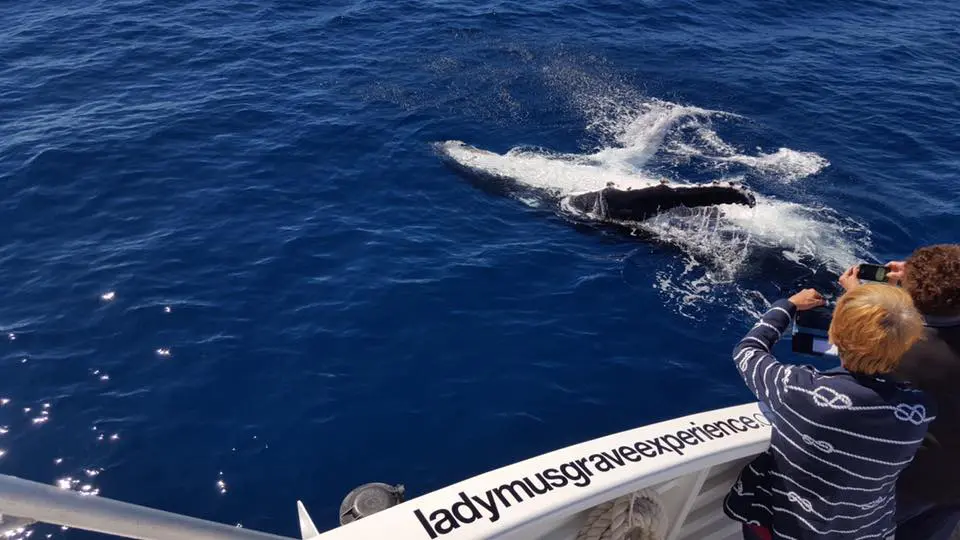
The whales you meet on our tours are, for the most part, not eating. Warm tropical water holds very little of what a humpback needs, so the northern half of the year runs on blubber laid down in the Antarctic. A nursing mother is doing this while producing hundreds of litres of rich milk a day — which is why undisturbed resting time in sheltered reef water matters so much, and why we approach slowly and let the whales set the terms.
Opportunistic feeding on baitfish is occasionally recorded on the east coast migration, and observations of it have increased in recent years — a reminder that even well-studied animals keep surprising researchers.
Why krill matters to everyone
Whale feeding fertilises the ocean. Iron-rich waste released near the surface feeds the plankton that krill in turn eat — a nutrient cycle that sustains the very swarms the whales depend on. Changes in sea ice and krill fishing pressure therefore reach far beyond the whales themselves. See the habitat guide for how the two ends of the range connect.
 BOOK A WHALE WATCHING TOUR