Most of a humpback's life happens underwater. The few seconds it spends at the surface carry almost everything we can observe — and each of those moves has a name and a purpose. Here's what the crew are calling out, and what it means.
Breaching
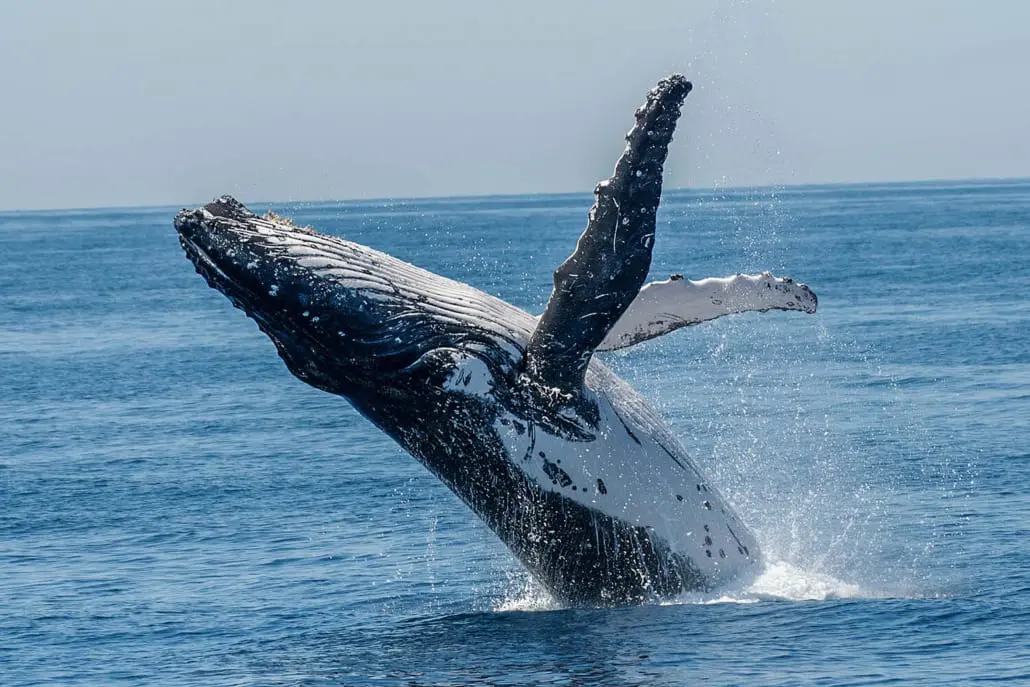
The whole animal launches clear of the water and falls back with an enormous splash. A 30-tonne adult needs serious speed to do it, so it isn't casual. Researchers link breaching to long-distance communication — the sound carries for kilometres — as well as to dislodging parasites, and to excitement in active social groups. Breaches come in series. See one, and keep your eyes on that patch of water.
Pec slapping
The whale rolls onto its side or back and repeatedly slaps a five-metre pectoral fin onto the surface. It's a percussive signal, and a favourite of relaxed whales lying at the surface. Mothers and calves do it together, and calves practise it endlessly.
Tail slapping and lobtailing
The fluke is lifted and brought down hard, over and over. It makes a crack you feel in your chest from a hundred metres away. Interpreted variously as communication, irritation or a warning to other whales — context tells you which. Peduncle throws, where the whale hurls the whole rear third of its body sideways, are the aggressive version, and they belong to competitive male groups.
Spy-hopping
The whale rises vertically, head out, and holds there — quite deliberately looking around above the waterline. Spy-hops near a stationary vessel are one of the clearest signs a whale is interested in you rather than the other way around.
Mugging
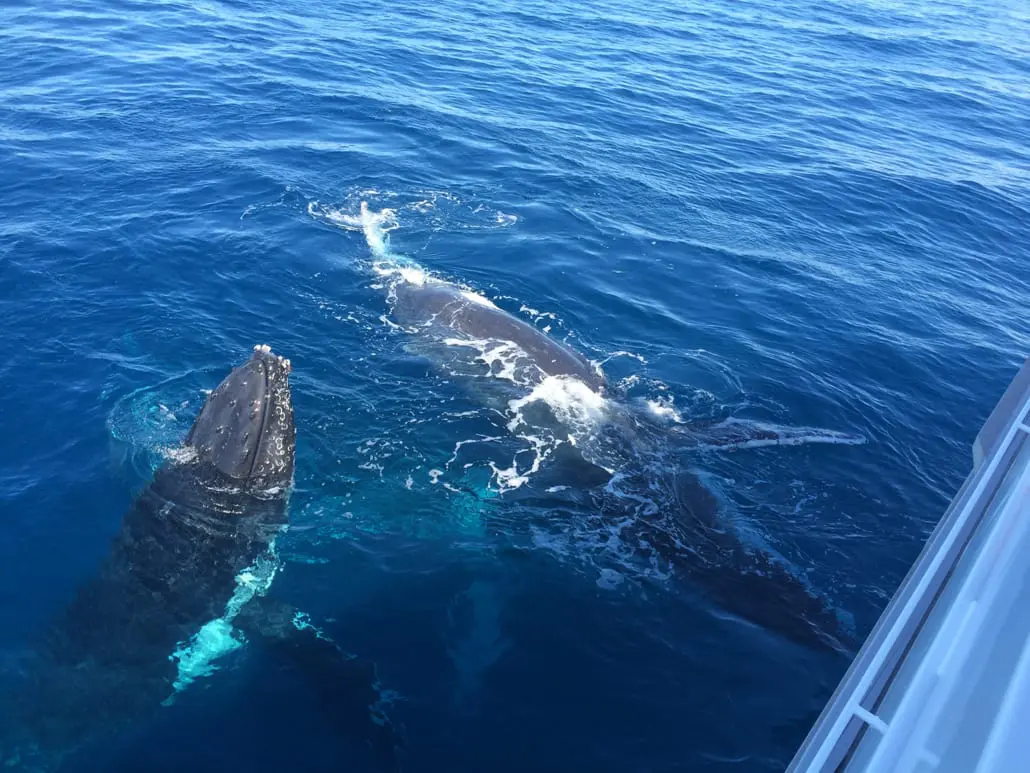
The word crews use when a whale chooses to come to the boat and stay there — circling, rolling, looking up at the people looking down. Under Australian rules the vessel must hold its distance, so a mugging can only ever be the whale's decision. Engines go to neutral and everybody stops talking. It's the best thing that happens out here.
Logging, blowing and fluking up
Logging is resting at the surface, motionless as a floating log — common in mothers conserving energy. The blow is the visible exhale, three to four metres high and bushy in a humpback. Fluking up — lifting the tail as the whale rolls into a dive — signals a deeper, longer dive, and gives photographers the classic shot.
Competitive groups and heat runs
Several males escorting one female at speed, jostling and displaying — bubble streams, head lunges, body blocks and the occasional collision. Loud, fast and spectacular, and most common on the northbound leg early in the season. See the migration guide for when to expect it.
Our crew narrate behaviour as it happens on every whale watching tour — what the whale just did, what it tends to mean and what's likely next. It's the difference between watching a splash and understanding a conversation.